

On Lay Learning and the Bible: Kirsten Macfarlane in Conversation with Adam Smyth and Lloyd Pratt
CEMS Global Early Modern Conversations II
Early Modern Literature Seminar
9 June 2026
Impression by Freya Abbas, DPhil student in English.
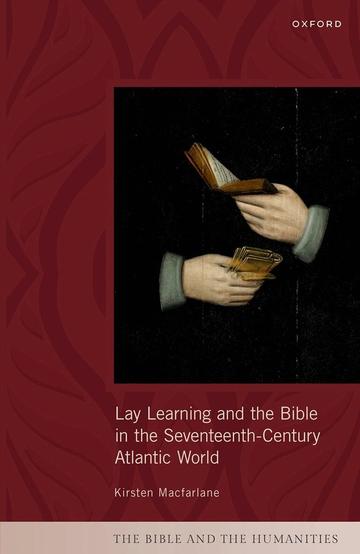
Kirsten Macfarlane is the Associate Professor of Early Modern Religious and Intellectual History at the University of Chicago,a full member of both the Divinity School and History Faculty, who did her doctoral work at Oxford in English Literature. She is the author of Lay Learning and the Bible in the Seventeenth-Century Atlantic World, published by Oxford University Press in 2025. The book aims to take the intellectual practices of a community of Puritan tradespeople seriously even though they were not university-educated. On 9 June 2026, Professor Kirsten Macfarlane discussed the research methods she used to reconstruct the transatlantic Broughtonian community. She was joined by Professor of History of the Book Adam Smyth and Professor of American Literature Lloyd Pratt, both of whom asked her questions about her book before the discussion was turned over to the audience.
Adam Smyth opened the conversation by asking Macfarlane about her use of archival research. Macfarlane described her method of research as open-ended. She was not sure what she would find when she came across the Broughtonian community in the archives, a network previously unmentioned in the secondary literature, which she reconstructed from their annotations of Broughton’s works. She described Hugh Broughton as a renowned but controversial Hebraist and a figure who disapproved of the King James Bible. He preferred to publish in English rather than in Latin, and in the form of pamphlets that would be accessible to lay readers. His readers made copious annotations of his work, which Macfarlane found very useful for reconstructing them as a community. Marcfarlane made the exciting point that speculative archival research still has the potential to uncover other lay learning communities that were previously unknown. This type of exploratory research may not yet be favoured by institutions and is perhaps best pursued as a side project by scholars, but it is necessary for allowing a theory of the lay reader to emerge.

1606 Hebrew map showing the dispersal of the sons of Noah around the world, hand-coloured and annotated by Edward Holyoke
Lloyd Pratt asked how we can decide if someone is a lay reader. Is there really a divide between lay readers and other types of readers? Macfarlane conceded that the term ‘lay reader’ was a problematic one, as was the term ‘amateur divine’, which she had previously considered. Both terms imply inferiority to another, more authoritative kind of reader, yet the implied opposition with ‘professional’ seems inappropriate within the wider cultural history of reading and learning.
An interesting theme that emerged from the conversation was autodidacticism. One of Macfarlane’s contributions to the field of early modern studies has been to highlight how much more common autodidactic practices were than previously believed. Early modern lay learners and autodidacts have had their abilities and interest levels underestimated by many modern scholars. Macfarlane reminded us that there were some impulses within Puritanism that helped facilitate informal learning networks.
Questions from the audience allowed Macfarlane to elaborate more on what the Broughtonians thought of their own identity and the styles of annotations that they used. Marcfarlane described the Broughtonians as idiosyncratic and eccentric, but also mentioned that they may not have thought of themselves this way; the tipping over of Puritan ideas from theological interpretation into a perceived heterodoxy was partly dependent on the possibilities and constraints of their location. Focusing on particular communities like the Broughtonians can allow a researcher to question the assumptions they may make about Puritanism. Macfarlane also suggests that there may be a way to unite scholarship on cultural history that normally does not engage with theology with the more abstract area of the history of ideas in order to gain a fuller understanding of the activities of these communities.
Macfarlane's work presents a history of learning that does not focus on formal institutions, and as a result it provides methodological inspiration for other scholars to seriously engage with the complexity of theological writings produced by communities of lay learners.

