Early Modern Conversations in Ecology: Bart Van Es and Francesca Southerden
Early Modern Literature Seminar
25 November 2025
- Professor Bart Van Es (English) ‘True Fire: Saint Augustine, the Climate Crisis, and Creative Non-Fiction’
- Professor Francesca Southerden (Italian) ‘Affective Ecologies in Petrarch’s Lyric Poems’
The first seminar under the heading Early Modern Conversations in Ecology – which deserves to inaugurate a new CEMS indisciplinary series – featured Professor Bart van Es and Professor Francesca Southerden, whose talks examined how ecological perspectives open new ways of engaging with premodern texts. Despite their different subjects and methodologies, both speakers explored forms of human entanglement with wider social, political, and environmental worlds.
Professor van Es presented his forthcoming publication True Fire: Saint Augustine in an Age of Crisis, provocatively characterising it as an “explicitly presentist” biography of Augustine. Far from downplaying the contextual semantics of Augustine’s ideas, van Es’s “presentism” develops into a multilayered project of comparative contextualism, bringing past and present into productive dialogue. Indeed, the book’s central premise is that our situatedness in an age of crisis provides a unique vantage point from which to understand how the social, cultural, and political collapse of the Western Roman Empire informed the unfolding of Augustine’s life and thought. In turn, van Es suggests, Augustine’s experience can illuminate our understanding of contemporary responses to the pressing issues of modern-day society, such as climate change and the rise of political extremism. As part of this project, van Es interviewed Roger Hallam, founder of Extinction Rebellion, whose response to climate crisis has taken the form of a radical and affective commitment to environmental activism, which van Es interprets in religious terms as a form of devotion to an objectively just cause.
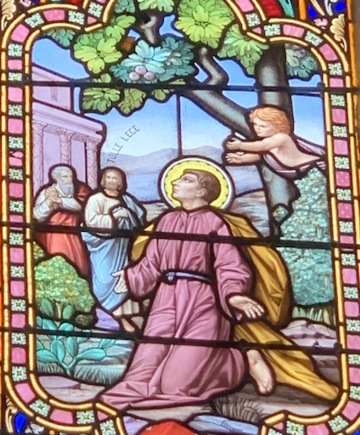
Image of Augustine in the garden in Milan, hearing 'tolle lege' ('take up and read'), as depicted in the stained glass window of the Basilique de Saint-Augustin in Annaba, Algeria, formerly Hippo Regius
The book argues that Augustine’s life was defined by a comparable devotional turn. His conversion to Christianity unfolded against the backdrop of a crumbling political order and a collapsing value system. Augustine came of age intellectually in the vibrant cosmopolitan environment of late fourth-century Milan, where he was educated in the relativistic thought of sceptics and rhetoricians. While this system entered an age of crisis, Augustine went radically against the relativist tradition of Roman intellectuals, embracing Christian revelation as a personal, unambiguous, and affectively charged commitment to objective truth. In the four chapters of the book, evocatively titled after the four classical elements, van Es traces the personal and political motives underlying the development of Augustine’s “activist” conscience: Chapter 1, titled ‘Air’, discusses Augustine’s engagement with the intellectual restlessness of Milan in 384 and the ethical emptiness of its rhetorical tradition; Chapter 2, ‘Water’, focuses on Augustine’s retreat to a villa in the countryside outside Milan in 386, where he prepares for and receives baptism; Chapter 3, ‘Earth’, is set in Ostia in 387, where Augustine’s planned return to Africa is complicated by an escalating political crisis. Finally, Chapter 4, “Fire,” turns to the end of Augustine’s life in 430, as the Roman Empire approaches its definitive collapse and Hippo, Augustine’s episcopal see, comes under siege by the Vandals.
In drawing parallels between Augustine’s life and our own, van Es reveals how crisis can become a catalyst for ethical and political commitment. True Fire offers a timely reflection on the relationship between conviction, activism, and the search for truth.
****
Professor Southerden presented her vibrant research for two current projects, the ongoing ‘Textual Ecologies’ project with longtime collaborator Manuele Gragnolati and her book project, tentatively titled Plant Love: Desire and the Vegetal Imaginary in Medieval European Poetry. In her presentation, she looked at ‘affective ecologies’ in Petrarch’s lyric poems. Taking a cue from Timothy Morton’s The Ecological Thought, Southerden approaches Petrarch’s lyric poems through a non-hierarchical ontology that situates human experience as integrally enmeshed within the vegetal environment. An example she discussed in her talk is the well-known twenty-third poem of the Rerum vulgarium fragmenta— Petrarch’s self-collected work of poems—in which the poet, falling in love, transforms into a tree, articulating the possibility a vegetal selfhood. Southerden reads this transformation as a “softening” of the lyric subject, indicative of the porosity, openness, and interconnectedness integral to plants. Becoming a tree, she argues, Petrarch can experience a new field of desire and intense forms of pleasure, which go beyond the dyadic relationship with the beloved Other, multiplying affect and opening the body up to the “expansive capacity” of the vegetal realm.
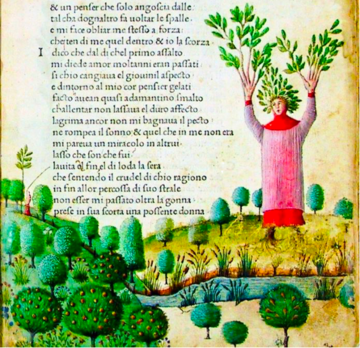
Antonio Grifo's illustration of Petrarch becoming a tree in Rvf 23, from a 1470 Venetian incunabulum [INC. G V 15] now in the Biblioteca Queriniana in Brescia
Southerden’s reading of affect exceeds the boundaries of subjectivity, as the unfolding of Petrarch’s affective experience lies precisely in the self-deconstruction of the lyric subject, whose love and identity are constituted through entanglement with the ecosystem in and through which they emerge. As Petrarch himself puts it, “Here Love reigns” (“Qui regna Amore”): love is not merely an interpersonal dyadic relation, but a pervasive environmental force that invests both human and non-human actors within a shared natural space, ultimately collapsing the distinction between the two categories. Thinking ecologically, Southerden suggests, can help us reconceptualise Petrarch’s ideas of affect, desire, and pleasure through a framework that moves beyond anthropocentric, dyadic, and heteronormative modes of interpretation.
Interestingly, besides looking at the ecological semantics of the text, Southerden also proposes a way of thinking “ecologically” about intertextuality itself. Drawing on Donna Haraway’s concept of “diffractive reading”, she conceptualises the world of Petrarchan lyric as an intertextual ecosystem in which individual lyric poems interact organically, generating meaning through their dialogic relations and illuminating one another in the process. Exploring the possibilities of ecology as a poetic topic and a theoretical mode, Southerden opens up new ways of reading Petrarchan poetics and the rich lyrical tradition it championed.
Impression by Kate McKee and Carlo Maria Zanetti, New College, DPhil Medieval and Modern Languages

