The Sorrowful Virgin: Medieval and Early Modern Devotion
St Hugh’s College, MGA Lecture Room, 24 March 2025.
Organised by Dr Anna Wilmore, Dr Taro Kobayashi, and Katerina Levinson
On 24th of March, Dr Anna Wilmore (French and German, St Anne’s and St Hugh’s), Dr Taro Kobayashi (Music, St Hugh’s), and Katerina Levinson (Spanish, St Anne’s and Wolfson) organised the workshop, ‘The Sorrowful Virgin: Medieval and Early Modern Devotion’, generously supported by the Centre for Early Modern Studies, Oxford Medieval Studies in association with The Oxford Research Centre in the Humanities (TORCH), and St Hugh’s.
This interdisciplinary workshop examined how devotion to Sorrowful Virgin Mary (Mater Dolorosa, Pietà, Seven Sorrows, Our Lady of Sorrows, etc) was manifested in the medieval and early modern periods. The workshop explored how liturgical and vernacular writers found in the Marian lament a vehicle through which the Virgin could speak, offering a route for affective engagement with Mary’s suffering. We took inspiration from Eliška Kubartová Poláčková’s 2023 monograph Medieval Laments of the Virgin Mary, which offers new insights into a medieval aspect of this devotion. The impetus for the workshop was to investigate wider questions related to her work about medieval affective piety and performativity in the Marian context, and whether this continued to manifest into the early modern period, or whether the Counter Reformation precipitated new developments or emphases.
The keynote was given by Prof Lesley Twomey of Northumbria, entitled ‘The Sorrows of the Virgin Mary at the Foot of the Cross in vernacular Vitae Christi in Medieval France, England, and Spain’. The full programme, including some videos, can be found here: https://medieval.ox.ac.uk/2025/01/16/cfp-the-sorrowful-virgin/
The workshop was hybrid, with several of our speakers presenting online. We had twenty in-person attendees, with a few extra people joining us for the performances in the afternoon, and a further twelve online.
The workshop included eight excellent academic talks. The first panel was entitled ‘Textual and Visual Devotion’, which focused on manifestations of the devotion in religious books, considering text-image relationships and was chaired by Irene van Eldere (Leiden and Oxford). Firstly, Susanne de Jong (Leiden) presented on a cycle of prayers about Mary’s Compassion which appears in Middle Dutch Books of Hours, generally attributed to Geert Grote. She highlighted the intertwining of this devotion with the Hours of the Holy Cross. Dr Fiammetta Campagnoli (Sorbonne) explored how the Virgin is portrayed both as pilgrim and guide to sacred spaces, such as Calvary and the Tomb, transforming devotional exercises into imagined journeys.
The second panel on ‘Sacred and Secular’ was chaired by Kat Smith (Lincoln College). Dr Joana Balsa de Pinho (Lisbon) showed how the iconography of the Sorrowful Virgin was used by the Confraternities of Mercy in the Early Modern Period as a way of building, individualising and affirming their own distinctive institutional identity, using a rich array of art and material culture to exemplify her argument. She was followed by Serena Cuomo (Santiago de Compostela) who argued that the iconography of the Virgin at the Foot of the Cross could be seen in Hecuba’s mourning in illuminated Roman de Troie manuscripts from Northern Italy, showing how this model of maternal grief had influence beyond the explicitly religious sphere.
The third panel, ‘Emotion and Trauma’ was chaired by Lucian Shephard (New College). Firstly, Costas Gavriel (Christ Church) explored how Leonor López de Córdoba identified with and imitated the Sorrowful Virgin in her Memorias, suggesting that this use of the Virgin was a powerful tool in dealing with her trauma. Ana Vitoria Lopes (São Paulo) drew on concepts from the History of Emotions in her examination of crying women in devotional panels, demonstrating how they acted as a model of emotion and devotion.
After a lunch break, we reconvened at the Weston Library for a manuscript workshop, in which we looked at five manuscripts and one early-printed book connected to the theme of the Sorrowful Virgin, several of which had links with the papers from earlier in the morning. Dr Matthew Holford showed us the texts using a visualiser while Anna Wilmore presented them, with a chance for participants to then look at the manuscripts. We are grateful to Prof Henrike Lähnemann for live-streaming the session to enable our online attendees to participate.

Participants looking at manuscripts in the Weston Library

Bodleian Library, MS Douce 243: one of the Middle Dutch Books of Hours that Susanne de Jong had discussed in her presentation.
On returning to St Hugh’s Montgomery Powell (Christ Church) presented a paper on the Bordesholmer Marienklage, showing how it enjoined its audience to participate in the Virgin’s Sorrows. This was followed by performance of a part of this medieval Low German lament in the St Hugh’s College Chapel. We then heard a performance of Mazzocchi’s Cristo Smarrito by Luke Mitchell (continuo) and Jessica Edgar (voice), which we were able to discuss, ably led by Dr Taro Kobayashi. We are grateful to Rev. Claire Browes for allowing us to use the chapel.
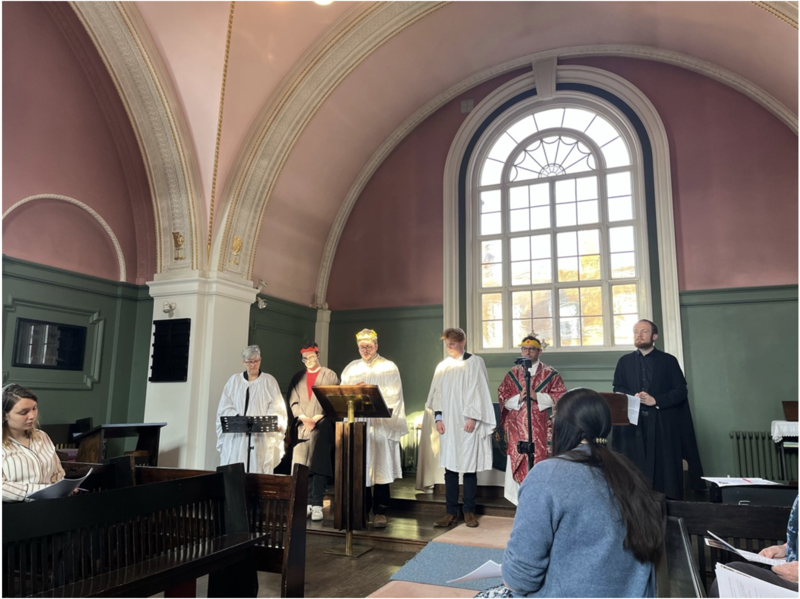
Performance of the Bordesholmer Marienklage by the St Edmund Consort.
The evening closed with Prof Lesley Twomey’s keynote talk, chaired by Prof Alice Brooke (Merton), which examined Isabel de Villena’s translation of a widely available Latin life of Christ. By situating Villena’s translation amongst French and English translations of Vitae Christi, this talk illuminated how Villena’s emphasis on the Virgin Mary and Mary Magdalene positions both women as female authority figures. In turn, Villena establishes her own credibility as a theological authority through her own translation, which emphasises new devotions with female protagonists. Moreover, Villena offers models of lamentation through the Virgin Mary and Mary Magdalene’s expressions of sorrow for devotees to imitate through affective piety. The talk offered insight into how transmission of knowledge and affectivity can offer women a voice in religion.
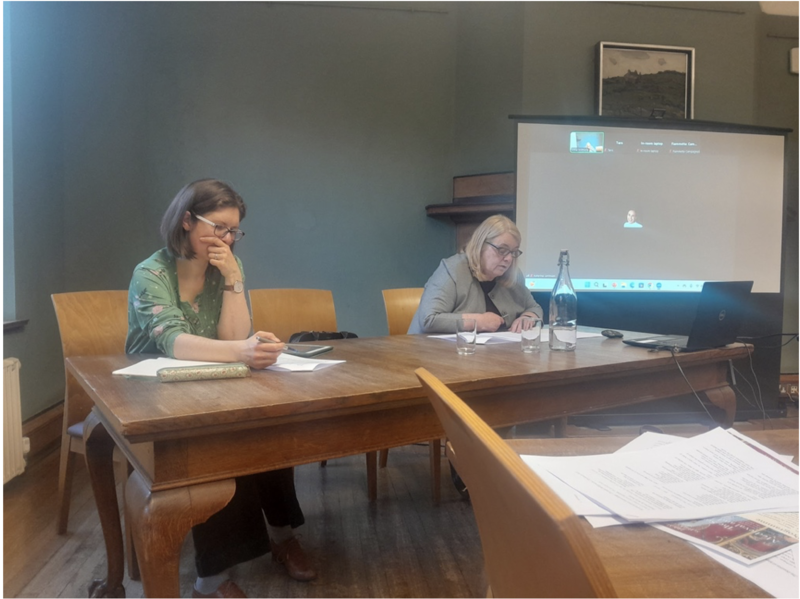
Prof Alice Brooke and Prof Lesley Twomey during the keynote.
We are very grateful to the Centre for Early Modern Studies for their support of our workshop, which included our morning coffee break, Prof Twomey’s travel costs and one night of accommodation.

